Showing posts with label art. Show all posts

Saturday, March 18, 2017

Retreat


This drawing--a souvenir of an afternoon alone to catch up with myself, time to take a long walk, to ignore the clock, then to retreat to my study with a withered tulip in a blue, glass vase and to play with pastels, enjoying the freedom of not knowing how to use pastels well, knowing only that I want the satisfaction of making marks on paper, of messy hands, of being lost in a process, of looking up, eventually, to find the delightful illusion of three dimensions on flat paper. 

---

How do you slow down and catch up with yourself? 

Sunday, September 11, 2016

Celebrating My Flatland Home


I visited some lovely places this summer including Saugatuck-Douglas on Lake Michigan and Peggy's Cove on the rugged coast of Nova Scotia. I relished being by the water. I was present, I was appreciative--and I was always glad to come back to my flatland home. Familiar walking paths, enormous skies, and corn along the roadways welcomed me back to the unassuming Midwest and grounded me. 

Here are some photos taken in one of my favorite places in Champaign-Urbana, the Idea Garden along Lincoln Avenue:


This photo and the next one were taken in the Idea Garden in 2014, during a plein air painting class I took through Community Education at Parkland College. The class was a lovely invitation to pay attention.


Tuesday, May 31, 2016

Double Vision and Second Sight


The first pot of the summer, as seen through our front door.
First, I noticed that traffic lights looked like three-leaved clovers, but aglow and blurry.

Then, driving east at dusk, I noticed the rising moon looked double, one white disk overlapping the other. I thought of the haunting Isaac Asimov short story I had read in college about a planet with two suns. More recently, I had watched the engrossing and disturbing film Another Earth, in which a second Earth appears in the night sky; leaving the movie theatre, I had examined the sky warily.

On this more recent evening, I knew I wasn’t really seeing two moons, but I was troubled enough by this double vision that I called my eye doctor and also, of course, looked up WebMD. 

It didn’t take long before I read that double vision was a common symptom of cataracts. So was second sight, the phenomenon of temporarily improved near vision which would then get worse.  That explained my wanting to look at my phone over the rims of my glasses, which had progressive lenses to help me see both close by and far away. 

I was young for cataracts, only forty-eight when they were diagnosed. I was given a new prescription for my glasses and told to wait a while.

A year and a half later, driving was more difficult and the moon was triple.  Grading papers was becoming challenging, with the text starting to float on the page. I found myself enlarging the font on the computer screen so that I could read and write emails. I was ready for cataract surgery.

Before my first surgery,
with my surgeon's initials above my right eye.
The surgeries were scheduled for earlier this month, one week apart, immediately after I turned in grades for the spring semester. I was nervous about the idea of the surgeon going at my eyes with tools, even though the surgeon is my eye doctor, whom I have known for years and trust completely. Nervous enough that I don’t remember what I read about the tools used.  I just repeated to myself that it was a routine surgery with a high success rate, and that since only one eye would be operated on at a time, I would not go blind as a result of the surgery. And not only would my cataracts be removed, but also the new lenses would give me near-perfect vision.

A drawing from my art journal after the first surgery.


The day after my second surgery, with my surgeon's
initials faded but visible above my left eye.
(I love accessories and am delighted I can now wear sunglasses without a prescription!)


Well, both surgeries were successful. I now have the remarkable experience of opening my eyes in the morning and seeing: the white embroidery on the white curtains, the print of a Derain painting on the wall between the windows, everything—and without glasses. I had been shortsighted since the fourth grade and needed progressive lenses as soon as I turned forty. Now I can see things far away and can see these words on a computer screen—all without glasses. This is new.  Startling. And wonderful.

The week after the first surgery, when I came home with 20/20 vision in my right eye, I would close my still-shortsighted left eye and marvel that I could see the purple iris in the backyard from the kitchen window without glasses. After the second surgery, I wandered around the gardens taking photos, in awe that I could see all that color, all that detail, all that glory without glasses.

When we first discussed cataract surgery, I said to my doctor, “You help people see! Don’t you feel like God?” I am an agnostic, but that was the best analogy I could manage.  After surgery, I feel like I am living inside a miracle. “Second sight” has a whole new meaning.


I feel fortunate that my surgeries were done just as the peonies bloomed.


I couldn't get enough color, so I took out my watercolors and played.


Monday, November 30, 2015

A UU Sermon about the Immigrant Experience


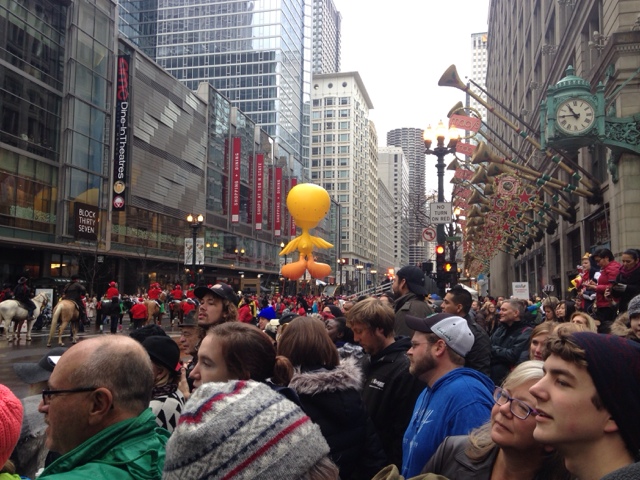
Every Thanksgiving, I remember my first one, back in 1984, when I ate my first turkey and watched my first Thanksgiving Parade--on TV, of course.  This year, Marilyn and I drove up to Chicago for the long weekend.  After watching the parade on TV as we sipped our coffee, we went down to State Street to watch the end of the parade just half a block from our hotel.

Last month, I was asked to participate in the service at the Unitarian Universalist Church of Urbana-Champaign, where Marilyn and I are members.  The service was going to be about the immigrant experience, and I was asked to speak about mine.  

This is the mini sermon I gave that day.   Below the text of the sermon is a link to the podcast of the entire service.

The Immigrant Experience – Sermon for October 18, 2015

When I was working on my PhD at Penn State in the nineties, I had a quote by Virginia Woolf pinned to the wall of my cubicle:  “As a woman, I have no country.   As a woman I want no country.  As a woman my country is the whole world.”  Last year, at the Made Fest that is part of the Pygmalion Festival in downtown Champaign, I found a world map—a print of a watercolor—that had these words painted above: “I have left my heart in so many places.”  That print now sits in my study.  These two quotes point to central aspects of my particular immigrant experience: feeling that I didn’t quite belong—for a very long time—and at the same time, making a home wherever I went.  I have a strong sense that parts of me will always be rooted elsewhere, that I began becoming who I am elsewhere—and because of that, I understand the outsider, the person who is new, the person who might not know the rules already.

For you to understand all this, it might help to know me as I introduce myself on my blog—which is titled, not surprisingly, Transplanted on the Prairie, (you are welcome to visit it; I post about once a month): “I am a reader, a writer, a teacher, and an artist. I was born in India, spent my adolescence in Kuwait [when my father took a job there], was educated in the eastern United States, and am at home in the Midwest. I came out as a lesbian soon after I graduated from college and now live with my life partner, Marilyn; we have been together since 1999, [we had a commitment ceremony in this church in 2006], and were able to marry legally in 2014.”  That’s me in a nutshell. 

One task facing a transplant like me is learning the rules, the conventions that others have grown up with and have known all their lives.  Though I was fluent in English—it has been my first language since soon after I began school at three and a half—and I was familiar with some American TV shows and had a few American friends in Kuwait, I had lived in India and then attended Indian schools (albeit English-medium Indian schools) in Kuwait.  I had traveled to Europe as a teenager but never to the United States.  So I had a lot to learn when I arrived at Cedar Crest College in Allentown, Pennsylvania, in 1984. 
            
“Why are you all dressed up?” my new friends asked when I arrived at the cafeteria in a black skirt, one I wore to go shopping back home. 

“I’m not dressed up.” 

“But you are in a skirt!”  I thought back to our orientation-week picnic and realized I had probably been the only one there in a skirt; I felt a little embarrassed.  But I didn’t own shorts, and my new jeans were too hot for August. 

I was fortunate: our college, a women’s college, assigned each freshman a junior Big Sister.  My Big Sis, Donna, had family close by, and both her mom and her eldest sister were alumnae of the college.  Together, that fall, they taught me about Halloween traditions, about Thanksgiving turkeys and parades—I spent that break at Donna's parents’ house—and even about Black Friday.  They taught me to layer to stay warm in the winter, helped me to buy comfortable walking shoes, and invited me to decorate their Christmas tree with them.  Those cultural guides and the human connection they provided eased my entry into this new culture, where the food was strangely bland and where young women were not physically affectionate with each other (the homophobia in the eighties was pronounced though not always spoken).  Without Donna’s family, I might have been much more lonely and definitely disoriented. 

I assimilated into my nearly lily-white college, where there were only six international students my first year (it now has students of many races and the college president is an African American woman). I made a home there which I love deeply and to which I still return.  That place holds my heart—and the people there, my other mentors, now beloved friends, influenced my deep connection.  But I knew all along that those friends did not know, could not know the complexities of the cultures I had inhabited and which had shaped me.  They could not know the delight of soaking in the first monsoon rain after an Indian summer or the taste of a perfect filafil sandwich from a roadside stand in Kuwait.  They did not know the privilege of being a light-skinned, middle-class, Hindu girl in India nor the disdain with which Indians were often looked upon in Kuwait. 

And that’s part of the immigrant experience.  You agree to be a partially-understood minority in order to make a new home which brings other opportunities and riches.

I first came to this church on the Sunday after September 11, 2001.   Coming here that morning is one of the best decisions I ever made.  Here, as the congregants—some of you—went up to light candles one after the other and spoke at this podium, I felt comforted.  I had received my green card just a few months before—I finally had permanence—but suddenly, the world had gone mad and South Asian immigrants were among those being targeted after the attacks of that Tuesday morning.  Marilyn’s brothers had called from Springfield, checking to see if I was okay.  At first, naively, I didn’t understand why they would even ask.  What did I have to do with the attacks?  But soon it became clear they had reason to be concerned.  In Connecticut, someone yelled at my brother outside his neighborhood Dunkin Donuts, telling him to return to his own country; my brother was months from becoming a U. S. citizen.  Marilyn asked, reluctantly, that I not wear my salwaar kameezes for a while.  In Western clothes, I am not immediately recognized as South Asian; she thought I’d be safer.  Here at the UU though, the people who spoke seemed to find the backlash disturbing, and they seemed to understand that “other lands have sunlight, too, and clover, and skies are everywhere as blue as mine."  (I always cry when I sing those lines).  Though the whole world feels like my country, I needed a home, and I found this church home, where I could rest my heart and stay a while.  

---

The podcast of the Oct. 18 service at the UU can be found here.

---

I post this with gratitude for the life of Rev. Dr. John R. Tisdale,  Professor Emeritus of Psychology at Cedar Crest College, dear friend, witty conversationalist, beloved husband, father, and grandfather.  Dec. 10, 1932-Nov. 28, 2015.

---

The parade as it neared the television cameras--a reminder that all is not as it appears on television.
(This was close to our hotel, so it's no wonder we could hear the music even up on the seventeenth floor, though we could see only a tiny sliver of it go by--if we craned our necks and rested our heads on the window pane so that we could see the street below.)

Walking on a street parallel to the parade route, we saw this float being deflated--an inadequate metaphor, but a metaphor nonetheless, for the realities of life in Chicago for so many black citizens, the realities not published in the tourist brochures: shootings by police, delayed investigations, justice deferred.
After the parade, we took a long walk in the rain.  I have crossed the Michigan Avenue bridge over the Chicago River many times.  The downtown of this Midwestern city feels like a home away from home.  

On Friday, Marilyn and I spent the afternoon at the Art Institute of Chicago.  On each visit, I like to visit the third floor of the Modern Wing, where I spend time with the Kandinskys.  You can see us in the reflection as we look out on Millenium Park.

Saturday, February 28, 2015

The Urge to Make Things


One of the yarn bowls I painted two evenings ago.  It will look very different once it is fired next week.


Two evenings ago, as the snow swirled outside the large windows of the Illini Union Bookstore, I listened enthralled to a reading by Andre Dubus III.  He urged the writers in the audience to write, that writing was the point, that being published was nice, but that we have to write in the face of the inevitable rejection letters.  He described writing his novel House of Sand and Fog in twenty-minute segments while sitting in his car before he went in to teach at one of several jobs he was juggling at the time.  

After the book became a bestseller, he worked  on building his family home. At his reading at the bookstore, he spoke of framing his daughter's bedroom.   His agent asked him if he couldn't now pay someone else to do that, couldn't he get back to writing?  He was writing, he told his agent, but he also wanted to build his daughter's bedroom, that it was like tucking her into her blanket at night.  

Dubus was describing making things.  He built his novel a piece at a time, and later, he built his family home.  They were both acts of creation.  

When I left the reading, I headed over to the Pottery Place, where I painted yarn bowls with a dozen other knitters.  Yarn bowls are ingenious containers that keep yarn from rolling away under the coffee table while one is knitting.  I had never painted pottery before, but my nephews have painted gifts for me.  As I chose colors and brushes and came up with a design, I felt like a child, playful and ready to experiment.  As I painted, I got lost in the process.  The blank surface of the bowl was like my blank computer screen or a blank page in my journal: an invitation to create something that had never existed before.  

I left the Pottery Place just as it closed, accompanied by another knitter, someone I had met for the first time that evening.  We talked about how remarkable it was that in this world of mass production, we had just painted bowls that were almost certainly unlike any others in the world, and how that was like the knitting we did, too, as we tweaked patterns, chose yarn, and knitted with our very personal tension, so that my stitches and hers would be different.

I came home wanting to write, to knit, to paint some more, and soon.  What I needed to do was to sit down at the kitchen counter to grade a paper.  The next morning, I had to teach, and to give feedback on a couple of dozen drafts.  And that was okay.  The delight and inspiration from my evening lightened the work I had to do, and I went in to campus the next day reminded that my students were creating, too.  

The cardigan I have been knitting and hope to finish before the winter is done.  I had to take apart over forty rows of over six hundred stitches and start the cardigan over in October, when I discovered I had twisted it when I joined it in the round,  but I haven't become discouraged yet.  

I finished knitting this hat last night.  I began it during one of the pauses in knitting the cardigan, when I had to wait to get advice about a next step.  


My favorite chair, where I often read and write and where I am writing this.  The red notebook is my journal.  I went through about half a dozen notebooks last year.  


Sunday, March 30, 2014

New Harmony in the Spring


On the grounds of the New Harmony Inn.  We always stay in a room facing the pond.


When Marilyn and I want to get away to somewhere quiet and peaceful, we head south to New Harmony, Indiana.  Sometimes, we stop for ice cream or pizza in one of the small eastern Illinois towns on our way.  Driving on, we predict when we will round the turn and encounter rows of bright green John Deere tractors available for sale.  Then we know we are getting closer.  We look forward to entering the familiar, sleepy, historic small town of New Harmony--population 850--where we always stay at the New Harmony Inn and always eat at least one meal at the Red Geranium Restaurant. The predictability is soothing.  

On March 21, as spring break began, we headed south again.

We found out that New Harmony is celebrating its bicentennial, and the weekend we were there, there was a "spring fling" with artists and other vendors in the small downtown.  "There are people on the street!" I exclaimed, laughing, as we walked around in the cold sunshine on Saturday.This brochure shows a design that incorporates the labyrinth, a landmark of this town founded by Utopians in the nineteenth century.
 

To show you how small the town is, I'm including the enlargement of the town center, which has the flashing stoplight marked prominently.  As we drove around when we first arrived on Friday evening, we were the only car in the town center, other than the Sheriff's patrol car parked on the corner.  Once we arrive, we don't drive either.  We can get everywhere we want to on foot.


This photo was taken in the small, round chapel off of the Great Room where breakfast is served.  Even when the Great Room is full of conversation and clatter, this chapel feels like a place for meditation.
Just outside the chapel, we encountered this piece, which we coveted for our backyard. Art like this is scattered all around New Harmony.  

This was carved into the back of a bench outside the town post office.  I love writing and receiving letters, so I had to photograph this.

We saw our first daffodils of the season!


I love the red door and white walls of this church.  (These are also the colors of our house).


This log house, next to the Red Geranium Restaurant, was built in 1814 and restored in 1959-60.


On Saturday afternoon, as the sun streamed into the Great Room of the Entry House, Marilyn worked on a quilt while I finished knitting the hat I had begun in January. 

We saw more signs of spring on our walk around the pond on Sunday morning.

Poetry can be found around New Harmony, too.  This was along a trail.  Auden wrote, "The trees encountered on a country street/Reveal a lot about a country's soul./A culture is no better than its woods." 
This is "Shalev: Angel of Compassion" by Tobi Kahn.  It is made of South Dakota granite and bronze.  In the distance, you can see the Wabash River.

Before we left town on Sunday afternoon, we walked the labyrinth.  These are our shadows.